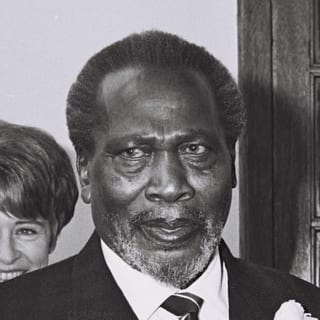
Jomo Kenyatta was Kenya's founding father: the anthropologist-agitator tried at Kapenguria who walked from a colonial prison to lead his country into independence and its first fifteen years. From Kenya African Union president to Prime Minister at independence in 1963 and President from 1964, he preached Harambee self-help, kept Kenya capitalist amid Cold War currents and drove rapid Africanization of the economy. His LSE-honed book Facing Mount Kenya remains a classic rebuttal of colonial anthropology. Critics weigh one-party drift, land-settlement inequities and silenced rivals against him; admirers answer with stability and growth rare among post-colonial states. He died in office in 1978, having stamped his family's name on Kenyan politics for generations.
Experience
Professional
- President, Kenya
1964–1978
former Prime Minister of Kenya
Government of Kenya 1963–1964
Kenya's first Prime Minister, leading the KANU government from internal self-rule through independence in December 1963 until the country became a republic a year later and the office was folded into the executive presidency he then assumed.
President
Kenya African Union (KAU) 1946–1951
Led the Kenya African Union from 1947, building it into the main vehicle for constitutional agitation against colonial rule until his 1952 arrest and the Kapenguria trial, which turned him into the imprisoned face of the independence cause.
Education
Social Anthropology (postgraduate diploma)
London School of Economics 1934–1937
Studied social anthropology under Bronislaw Malinowski at the London School of Economics during his long stay in Britain, producing Facing Mount Kenya in 1938, a landmark ethnography of the Gikuyu people that doubled as a defence of African culture against colonial narratives.
Reviews
No public reviews yet. Be the first to review.
Review President Jomo Kenyatta
Sign in to leave a review.
Ask Jomo
Answers come from the manifesto and public updates, instantly.